
Oneida County Deed Records by Instrument
A deed tells you what changed in a land interest, and the instrument type shapes the story. A warranty deed promises clean title. A quitclaim conveys only what the grantor holds. Personal-representative and correction deeds serve narrower purposes. Treat the table as a reading aid, not proof that each form covers every transaction. The Register of Deeds records the instrument; an index hit alone never resolves title.
| Instrument | What It Does | Common Record Use |
|---|---|---|
| Warranty deed | Conveys the described interest with deed warranties stated in the document | Track a sale or other transfer |
| Quitclaim deed | Transfers whatever interest the signer holds, without the same title promises | Review a family, estate, or corrective transfer |
| Personal representative deed | Conveys estate property through a personal representative | Connect probate authority to the land record |
| Correction instrument | Amends or clarifies a prior recorded item as its text allows | Check a name, description, or reference issue |
| Mortgage and satisfaction | Records a loan interest and later release when filed | Follow an encumbrance through release |
| Plat or CSM | Creates or depicts a land division and lot description | Match a legal lot to a parcel map |
In Wisconsin, a mortgage is the land-record instrument behind a secured property loan. Old entries can mislead. Read the signed document plus any later release, assignment, or amendment, and never infer a balance from a stale filing.
Searching Oneida County's Party Index
The Register of Deeds offers a Grantor/Grantee page with separate search modes, a user guide, and an exceptions document. A grantor conveys an interest. A grantee receives it. To trace a transfer, find the current owner's deed as grantee first, then note the seller and search that party's earlier deed as grantee. Each result must tie back to the parcel's legal description. Names alone can lead you astray.
- Use Ascent or GIS to capture the Oneida parcel number and full legal description.
- Search the known current party as grantee in the county index and compare dates and descriptions.
- Open the deed image or note its document number, recording date, and book/page reference.
- Take the prior grantor's name and search backward as grantee; resolve name variants against the legal description.
- If the party index stops, shift to the pre-1997 tract books or ask the Register of Deeds to locate the older instrument.
- Grantor
- The party conveying an interest in a recorded instrument.
- Grantee
- The party receiving the stated interest.
- Chain of title
- The sequence of recorded transfers tied to the same land description.
- Book and page
- A volume/page reference; a document number may be used in another system.
Oneida County Index and Image Coverage
RecordEASE indexing starts December 19, 1979, while images reach back to January 5, 1887. That gap matters. A deed image may be retrievable by reference or legal description even when a modern name search misses it. The separate pre-1997 tract index bridges older entries. Its scanned books date to 1888. The county's RecordEASE access page spells out the time ranges and the account route.
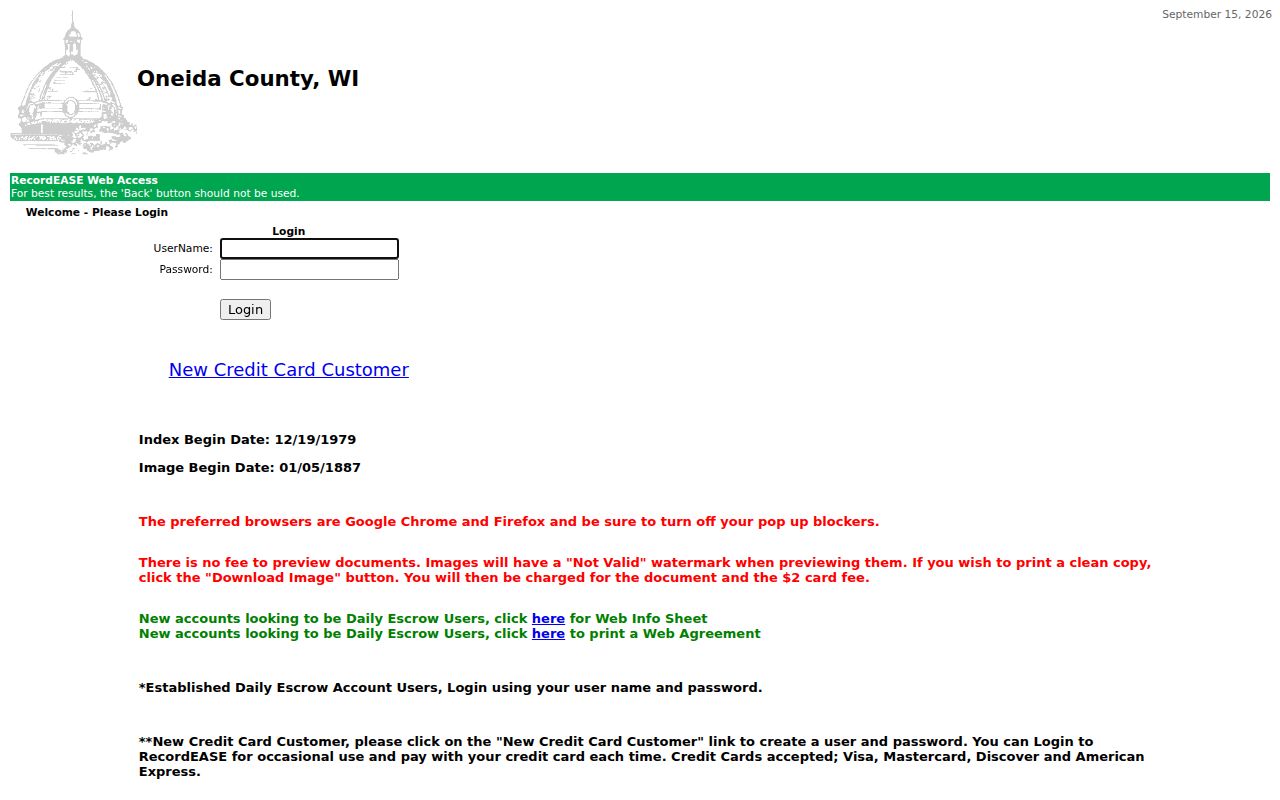
Always check the displayed dates before concluding a deed is missing from the online index. RecordEASE's public page offers free image previews. These are marked “Not Valid.” A clean download costs per page. A card convenience charge applies per login session. That distinction matters when you need a legible copy. For certification, request a certified copy from the Register of Deeds. Do not treat a downloaded preview as official.
Walking Back from a Oneida County Deed
A party-name chain holds up only when each step matches the land. A familiar name alone is not enough. Note each instrument date, party, document reference, and legal description. Older entries vary widely. One deed may cover a whole section. Another may cover a subdivision lot, or a parcel whose street address was assigned much later.
| Transfer Step | Party Role | What to Match | Next Search |
|---|---|---|---|
| Current deed into owner | Current owner is grantee | Parcel description and recording reference | Search the grantor as grantee |
| Prior transfer | Earlier owner is grantee | Same tract, lot, or section | Repeat through earlier grantors |
| Older tract entry | Party name may be indexed by land | Town, range, section, subdivision text | Use manual tract book or office help |
Legal descriptions change over time. A CSM, plat, correction, or split may connect the old form to the new one, and the recorder index alone will not reconcile them.
Reading an Oneida County Deed Image
After an index match, open the instrument itself. Check the grantor and grantee names, the conveyance language, and the legal description. Look for signatures, notary blocks, the recording stamp, and references to prior instruments. The stamp shows when the document entered the public record. It says nothing about later performance.
For a transaction, also trace later assignments, releases, corrective instruments, and deeds. A mortgage may be followed by an assignment and satisfaction. An easement can outlast a change in owner. RecordEASE indexes carry exceptions. Read the exceptions PDF and guide linked from the county's Grantor/Grantee page if a party search seems incomplete. Those materials explain what the index may skip.
Older Oneida County Tract Books
The pre-1997 manual tract index is more than a fallback for a failed web search. Its selectors cover year, town, range, section, and subdivision or condominium. Scanned volumes reach back to 1888 in some cases. This land-first approach shines when a nineteenth-century deed sits under a tract rather than a modern address. It also helps with unexpected name spellings. The county's manual tract-index archive provides the scan route.
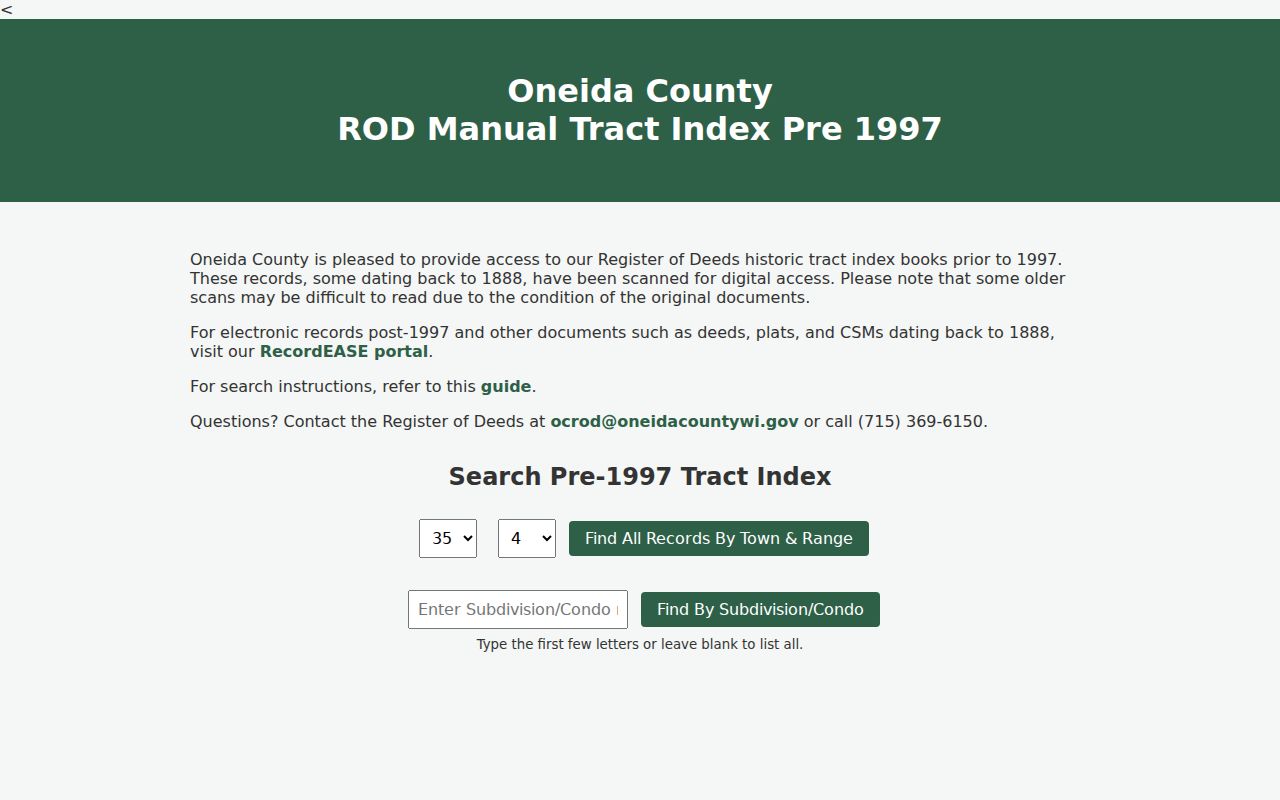
The selectors make the older route visible, but old scans can be faint. Start from a current parcel's legal description. Narrow to the township and section. If an image is cut off or unreadable, note the book and page and ask staff for help locating an original or clearer copy. Not every volume is digitized.
Oneida County Deed Copy Fees
RecordEASE shows a free watermarked preview of any deed image. A clean download costs $2 for the first page. Each additional page adds $1. A single $2 card convenience fee applies once per login session. Further convenience fees kick in above $66. The portal takes major cards and states that card data is not retained. Vendor terms can change, so confirm the current price before ordering.
A downloaded file is not a certified copy. Lenders, courts, estates, and title professionals usually need a certified instrument instead. For that, ask the Register of Deeds about the request form and certification. Ask about the current copy cost too. The web schedule may not cover counter or mailed-copy fees. Do not assume they match.
Oneida County Plats, CSMs, and Legal Descriptions
Plats and certified survey maps tie deed language to a defined lot. Oneida County's NCWRPC repository holds parcel maps by town, range, and section. It also holds survey notes and PLSS corners. Historic books and roads are there too. Early twentieth-century plat material appears as well. RecordEASE also serves deed, plat, and CSM images across its image range. These records can explain a cottage lot or a later split. An address alone may not identify the original land.
Search with the exact lot, block, subdivision, CSM, and recording reference. A map scan orients you. A line on a GIS display, however, is not a survey. For map layers and broader parcel sources, see the Oneida County parcel map information.
Oneida County Deed Search Limits
A recorded deed is only one item in a title history. The index can miss a name variant. It can also miss an older tract reference, or an instrument filed under a different party role. Images are sometimes too faint to read. Follow any deed search with review of related instruments. Add a check of the legal description too. The property may sit inside an estate or court matter. In that case, probate and court records may explain how the conveyance occurred.
Recorded is not the same as guaranteed. A search result does not prove clear title, erase an unrecorded claim, or decide a legal boundary. Confirm the instrument with the Register of Deeds and obtain a title review when a purchase or legal decision depends on the chain.
Capture a Citation for Each Deed Image
When an index result seems to match the parcel, write down the details first. Capture the grantor and grantee spelling first. Then add the instrument type, recording date, document or volume reference, and the legal description before moving on. Those notes make it easy to return to the right image. This helps if the session ends or the name is a common one.
Compare the description against the current tax parcel. Also check any plat or CSM named in the instrument. A street address alone may not connect an older conveyance to today's lot. If a listed image is faint or incomplete, record what is legible. Then ask the Register of Deeds about a clearer copy. For a chain gap, search both party names and the land description. Ask whether an older tract-book reference or archived index can help. A citation is a research aid, not a legal conclusion about title.
Keep UCC Filings Separate from Real Estate Deeds
Wisconsin's UCC search is a different tool from the Oneida County Register of Deeds index. A financing statement reports a security interest in specified collateral. It does not itself prove that a named debtor owns a parcel. It also does not convey real estate. When a business name shows up in both systems, compare the exact entity name. Compare the filing dates as well. Then read the underlying land instrument for the parcel's ownership history. The state Department of Financial Institutions provides the UCC debtor and secured-party search:
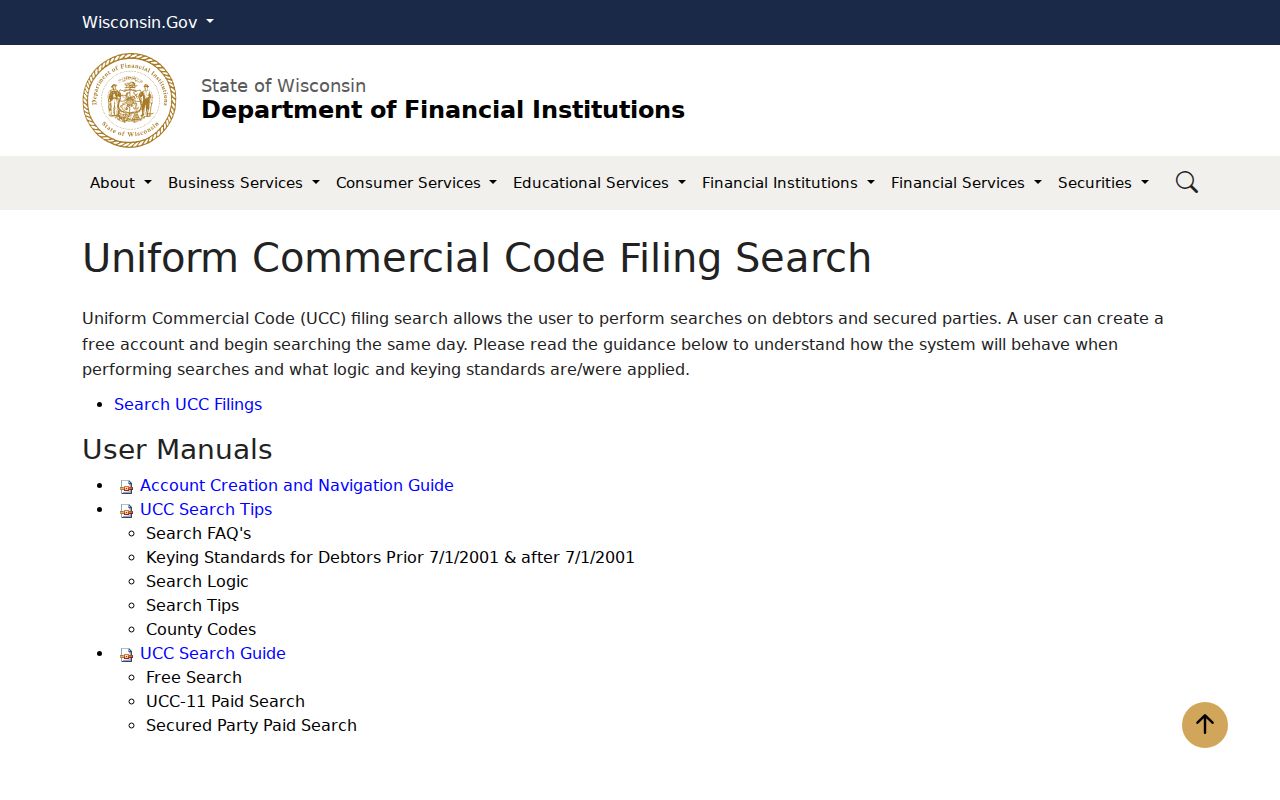
The state entry page suits questions about a UCC filing. Use the county deed index for recorded real estate conveyances. Ask the appropriate custodian for the actual filed record.